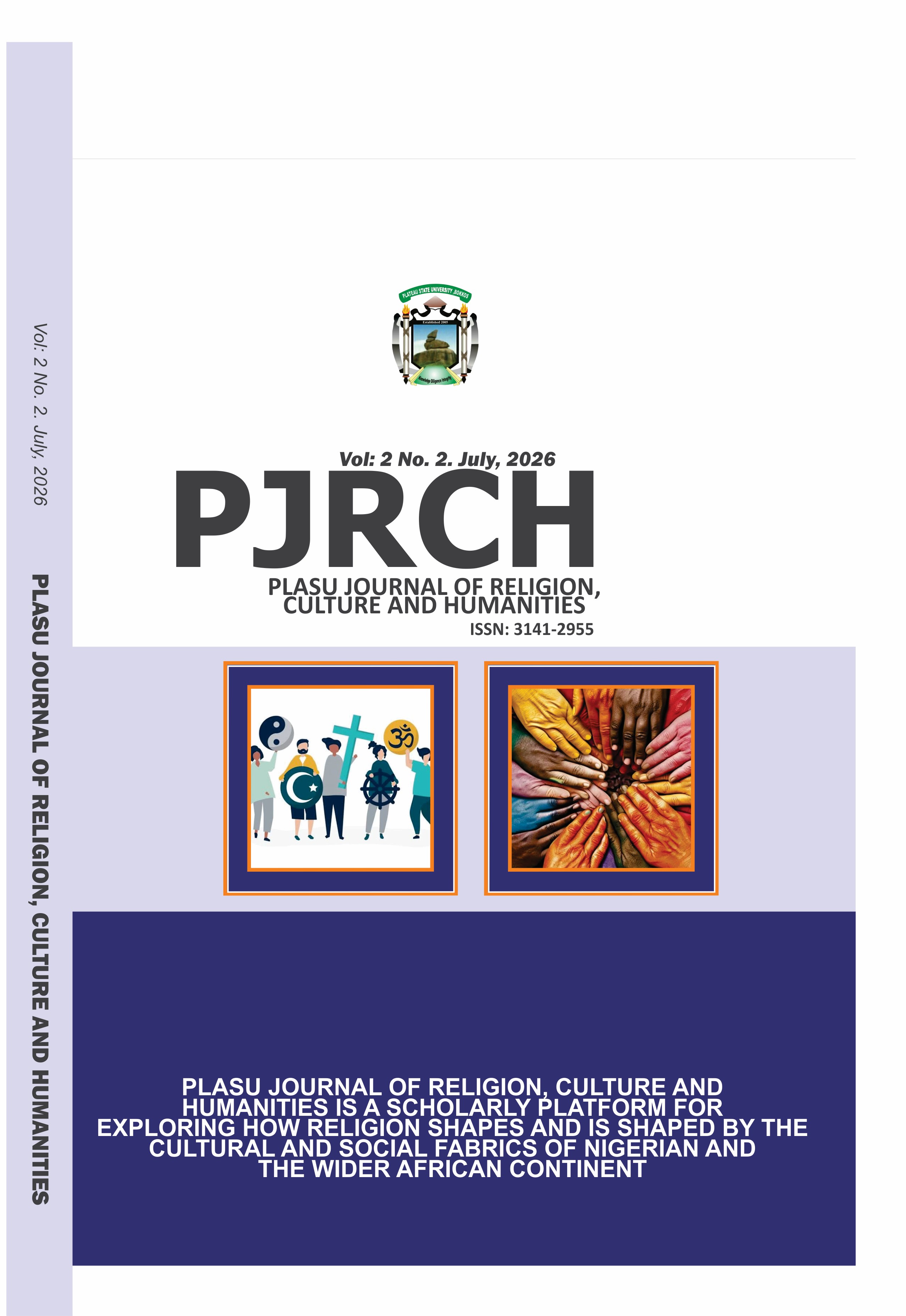
SPIRITUALITY, POWER, AND CORRUPTION: UNDERSTANDING THE PARADOXOF HIGHLY RELIGIOUS AFRICAN SOCIETIES
DOI:
https://doi.org/10.68653/na13xj72Keywords:
Religiosity, Corruption, Moral Authority, Governance IntroductionAbstract
Religion has historically functioned as a central moral regulator in African societies, shaping ethical conduct, communal cohesion, and leadership accountability. Yet, paradoxically, many African nations, particularly Nigeria, exhibit persistent corruption, weak governance structures, and eroded social trust despite high levels of religiosity. This study critically examines the complex interplay between spirituality, moral authority, and corruption in African contexts, with a focus on Nigeria, seeking to understand why profound religious commitment does not automatically translate into ethical governance. This study employs a qualitative, desk-based methodology, the study analyses secondary data from scholarly publications, empirical reports, and institutional assessments. The study also adopts an interdisciplinary lens that incorporates sociology of religion, political science, and ethics.
Conceptually, the research draws on Weber‟s theory of authority, the moral economy framework, and the instrumentalisation of religion, highlighting how religious institutions may simultaneously serve as moral guides and instruments of political legitimization. The study finds that while Christianity, Islam, and African Traditional Religion (ATR) retain ethical framework, their moral authority is frequently compromised through political patronage, prosperity-oriented doctrines, and erosion of indigenous communal sanctions. This compromise fosters ethical relativism, normalizes corruption, undermines governance, hampers national development, and weakens social cohesion. Nevertheless, the research identifies pathways for moral renewal, including reinforcing ethical accountability within religious institutions, promoting civic and religious education, reclaiming the prophetic role of religion, maintaining institutional autonomy from political co-optation, and leveraging religion as a tool for sustainable development. The study concludes that reclaiming ethical spirituality is indispensable for restoring public trust, promoting accountability in governance, and fostering sustainable development in African societies. Ultimately, the research contributes to understanding the paradox of religiosity and corruption, demonstrating that religion, when ethically anchored, can transform from a legitimizer of power into a catalyst for moral and social transformation.
References
Afolayan, A. (2022). The crisis of moral leadership in Africa: Ethics, governance, and social responsibility. Ibadan: Safari Books.
Agbiji, O. M., & Swart, I. (2019). Religion and social transformation in Africa: A critical and constructive engagement. Scriptura, 118(1), 1–14. https://doi.org/10.7833/118-1-1720
Akinade, A. E. (2020). African religiosity and the challenge of moral integrity in the public sphere. Journal of Theology for Southern Africa, 167, 45–62.
Ayantayo, J. K. (2021). Religion, morality and corruption in Nigeria: An ethical appraisal.
Ilorin Journal of Religious Studies, 11(2), 1–18.
Casanova, J. (2019). Global religious and secular dynamics. Leiden: Brill.
Danfulani, U. H. D. (2020). Religion, legitimacy and power relations in contemporary Nigeria.
Jos Journal of Humanities, 14(1), 23–41.
Ellis, S., & ter Haar, G. (2020). Religion and politics in sub-Saharan Africa (2nd ed.). Cambridge: Cambridge University Press.
Gbadamosi, G., & Adebayo, F. (2023). Religious symbolism, political patronage and corruption narratives in Nigeria. African Journal of Social Sciences, 13(2), 89–105.
Ibrahim, J., & Osaghae, E. (2019). Nigeria: Politics, economy, and society. London: Zed Books.
Kalu, O. U. (2021). African Christianity and public morality in the twenty-first century. Studies in World Christianity, 27(3), 256–272. https://doi.org/10.3366/swc.2021.0354
Marshall, R. (2019). Political spiritualities: The Pentecostal revolution in Nigeria. Chicago: University of Chicago Press.
Mbiti, J. S. (2019). African religions and philosophy (Reissued ed.). Oxford: Heinemann.
Obadare, E. (2018). Pentecostal presidency? Religion, power and politics in Nigeria. Journal of Modern African Studies, 56(3), 475–497. https://doi.org/10.1017/S0022278X18000315 Obidah, S. (2022). Indigenous moral systems and the crisis of communal ethics in Northern Nigeria. Nigerian Journal of Sociology of Religion, 7(1), 61–79.
Oluwaseun, A., & Lawal, T. (2024). Religion, public trust and moral accountability in sub-Saharan Africa. African Governance Review, 6(1), 33–52.
Onapajo, H. (2020). Religion and political mobilisation in Nigeria: Beyond piety and devotion.
Journal of Contemporary African Studies, 38(4), 471–486.
https://doi.org/10.1080/02589001.2020.1728473
Sofi, T. G. (2023). Indigenous values, moral authority and social cohesion in contemporary Nigerian society. Journal of African Religious Thought, 5(2), 14–32.
Transparency International. (2023). Corruption perceptions index 2023: Sub-Saharan Africa.
Berlin: Transparency International.
Ukah, A. (2022). Prosperity, power and prophecy: Moral contradictions in African
Pentecostalism. Religion Compass, 16(3), e12425. https://doi.org/10.1111/rec3.12425
Weber, M. (1978). Economy and society: An outline of interpretive sociology (G. Roth & C. Wittich, Eds.). Berkeley: University of California Press.